2026 Top Metal Laser Cutter Types for Global Buyers

Choosing a metal laser cutter in 2026 requires more than comparing wattage and purchase prices. Global buyers must examine material thickness, production volume, automation needs, maintenance access, and local service support. A machine cutting thin stainless steel may struggle with heavy carbon steel. The opposite can waste energy and floor space.

This guide introduces the leading metal laser cutter types used across fabrication shops, contract manufacturers, and industrial production lines. It considers fiber laser systems, compact sheet machines, tube and pipe cutters, high-power platforms, and automated cutting cells. Each type offers a different balance of speed, accuracy, operating cost, and flexibility. Real workshop conditions matter. Dust, unstable power, limited technical staff, and difficult spare-parts access can change the final decision.

Numbers need context. A higher laser power rating does not guarantee better productivity for every order. Cutting quality also depends on the source, lens, nozzle, gas control, software, and operator experience. Small details matter. A poorly aligned nozzle can leave rough edges on a valuable stainless-steel part. Buyers should request sample cuts, inspect tolerances, and confirm after-sales response before signing a contract.

This overview aims to support careful, evidence-based purchasing. It reflects common industry practices, yet no single recommendation fits every region or factory. Some comparisons remain conditional. Technology changes quickly, and this guide may require revision as new sources and automation features mature. Reliable decisions begin with verified specifications, realistic production data, and honest conversations with qualified suppliers.
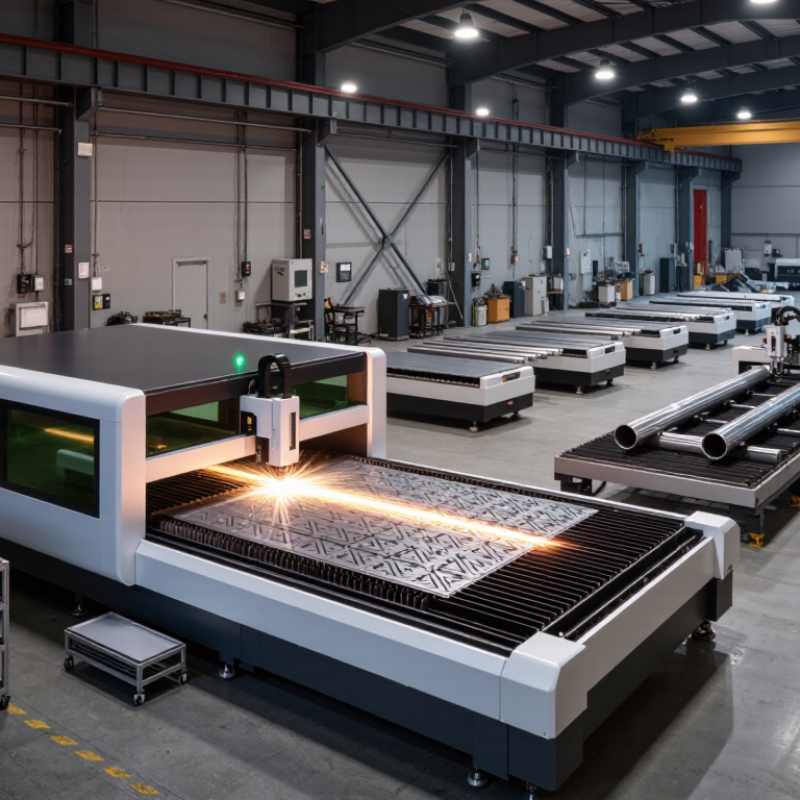
2026 Top Metal Laser Cutter Types for Global Buyers

Laser Source Taxonomy: Fiber, CO₂, Disk, and Nd:YAG Cutting Systems

2026 Top Metal Laser Cutter Types for Global Buyers

Laser Source Taxonomy: Fiber, CO₂, Disk, and Nd:YAG Cutting Systems

Fiber lasers dominate many modern metal shops because they convert electrical power efficiently. Their focused beam cuts mild steel, stainless steel, aluminum, and brass with strong speed. Thin sheet often shows a narrow kerf and limited heat distortion. In daily production, operators still need clean lenses, stable gas pressure, and accurate focus. A powerful source cannot repair poor setup.

CO₂ lasers remain useful for mixed-material workshops. They can process metals, plastics, wood, and other nonmetal materials with suitable configurations. Their longer wavelength may require more care when cutting reflective metals. Mirrors and beam paths also demand regular alignment checks. This maintenance burden is easy to underestimate.

Disk lasers offer high beam quality and strong thermal stability. They suit demanding production where consistent edges matter across long shifts. Nd:YAG systems use a solid-state source and can support fine cutting, marking, and specialized fabrication. However, their practical value depends on thickness, pulse control, service access, and operating cost.

I would not choose a source from power ratings alone.

A test cut reveals more. Record burr height, edge color, piercing time, and gas use before signing a purchase. The best decision may still change after real material trials.

Fiber Laser Cutters: 1.06–1.08 μm and 30–40% Wall-Plug Efficiency

Fiber laser cutters remain a practical choice for global metal buyers because their beam wavelength usually sits between 1.06 and 1.08 μm. This near-infrared range couples efficiently with steel, stainless steel, and aluminum. Industrial system surveys commonly report wall-plug efficiency near 30–40% for modern fiber sources. Fraunhofer ILT technical reviews also identify fiber delivery and high electrical efficiency as major advantages in automated cutting.

The figure needs careful reading. It describes source efficiency, not the complete machine. Chillers, extraction units, motion drives, and compressed gas still consume power. The U.S. Department of Energy’s Industrial Decarbonization Roadmap (2022) treats process energy reduction as a key manufacturing priority. That supports comparing total kilowatt-hours per cut, rather than laser power alone. Real workshops are messier. Dust, reflective aluminum, unstable voltage, and poor nozzle alignment can reduce output. A 30–40% claim may also vary with power level, duty cycle, and measurement method. Buyers should request test data under their own material thicknesses and production speeds. A supplier’s efficiency table is useful, but it is not independent proof. Production trials remain necessary.

2026 Top Metal Laser Cutter Types for Global Buyers

Fiber Laser Cutters: 1.06–1.08 μm wavelength and approximately 30–40% wall-plug efficiency.

The chart compares representative wall-plug efficiency ranges for common industrial metal-cutting laser technologies. Actual efficiency varies with laser power, operating conditions, cooling systems, and equipment configuration.

CO₂ Laser Cutters: 10.6 μm and 8–15% Wall-Plug Efficiency

CO₂ Laser Cutters: 10.6 μm and 8–15% Wall-Plug Efficiency

CO₂ laser cutters use a 10.6 μm infrared wavelength, mainly produced by a gas discharge tube. This wavelength is well suited to carbon steel, stainless steel, aluminum, acrylic, wood, and other industrial materials. For global buyers, wall-plug efficiency deserves close attention. It measures laser output power against total electrical input. Typical CO₂ systems deliver about 8–15% efficiency, depending on tube design, power level, cooling, and alignment.

8–15%
Wall-plug efficiency

That figure affects operating cost. A 4 kW laser output may require roughly 27–50 kW from the electrical system, before adding chillers, motion controls, extraction, and compressors. Real power demand can be higher during acceleration or standby cycles. Shop evaluations should use a calibrated power meter, not only the value printed on a specification sheet. Check cutting speed at a defined thickness, assist-gas pressure, kerf width, and edge quality. Small changes matter.

Reflective metals require extra care. Aluminum and copper can send energy back toward the optics, especially during unstable piercing. Protective windows, correct focus, and controlled gas flow reduce practical risks. Maintenance also influences efficiency; dirty mirrors and weak cooling can lower output gradually. I have found that clean optics often improve consistency more than aggressive power increases. Still, the 8–15% range is not a promise. It is a working estimate, and each machine should be judged through measured energy use and finished parts.

Machine Formats: Flatbed, Tube, 3D, and 5-Axis Laser Cutters

In 2026, global buyers are comparing metal laser cutter formats, not only laser power. Grand View Research estimates the laser cutting machine market will grow at about 8% annually through 2030. The right format depends on material shape, tolerance, floor space, and production rhythm. Flatbed cutters remain the practical choice for sheet metal. They handle steel, aluminum, and stainless steel with repeatable positioning. A 3,000 × 1,500 mm bed suits many fabrication lines. However, oversized tables can waste space when daily orders are small.

Tube laser cutters serve round, square, and rectangular profiles. They reduce secondary drilling and improve hole alignment. MarketsandMarkets reports rising automation demand in metal fabrication, driven by labor shortages and faster production targets. 3D laser cutters suit formed panels, automotive structures, and irregular surfaces. Their sensors must compensate for changing angles and height. Five-axis laser cutters offer controlled access around complex parts, including bevelled edges and deep contours. They cost more and demand stronger programming skills. More axes do not automatically mean better output. That assumption deserves review.

Tips: Confirm the largest real workpiece, not the advertised maximum. Request sample cuts using your actual thickness and alloy. Check kerf width, piercing time, assist-gas use, extraction performance, and operator training. Fortune Business Insights projects continued growth in the global laser cutting machine market, but forecasts vary by research method. Treat them as planning references, not guarantees. A machine that looks advanced may still be inefficient for simple flat sheets.

2026 Top Metal Laser Cutter Types for Global Buyers - Machine Formats: Flatbed, Tube, 3D, and 5-Axis Laser Cutters

Machine Format Primary Motion Format Typical Working Envelope Suitable Metal Materials Typical Cutting Range Best-Fit Applications Main Advantages Key Limitations Typical Buyer Profile
Flatbed Laser Cutter Two-dimensional X-Y cutting head over a stationary sheet or plate; the Z axis maintains the focal height. Common sheet formats include approximately 1,500 × 3,000 mm 2,000 × 4,000 mm 2,500 × 6,000 mm Carbon steel, stainless steel, aluminum, galvanized steel, brass, copper and selected coated metals. Approximately 0.5–25 mm for many fiber-laser configurations, depending on laser power, material grade, gas, nozzle and process settings. Sheet-metal fabrication, enclosures, brackets, machinery parts, electrical cabinets, automotive components and general industrial production. High productivity on flat sheets; efficient nesting; broad material compatibility; relatively simple programming; easy integration with loading and unloading systems. Not designed for complete tube processing or cutting complex formed surfaces; large sheet models require substantial floor space and material-handling equipment. Fabricators, contract manufacturers, metal-service centers, machinery suppliers and high-volume sheet-metal workshops.
Tube Laser Cutter Rotary chuck or synchronized tube-processing system combining linear movement with tube rotation; some machines also include a tilting or bevel-capable cutting head. Typical round-tube diameters: 20–230 mm 20–350 mm
Typical square or rectangular profiles: up to about 250–300 mm
Carbon-steel tube, stainless-steel tube, aluminum profiles, galvanized tube, brass and other conductive structural profiles compatible with the machine specification. Common wall-thickness capability is approximately 0.8–12 mm; heavier sections are possible on higher-power systems with suitable chuck capacity and process conditions. Frames, racks, furniture, construction profiles, agricultural equipment, automotive structures, handrails and tubular machine components. Cuts holes, slots, miters and contours in one setup; reduces drilling, milling and fixture operations; improves repeatability for profile assemblies. Limited by tube diameter, profile size, straightness, wall thickness, loading length and residual-stress behavior; less suitable for large flat plates. Structural fabricators, furniture manufacturers, equipment builders, construction-product suppliers and workshops processing high volumes of profiles.
3D Laser Cutter Multi-axis cutting head or robot-mounted laser follows three-dimensional surfaces; the system continuously controls focus and cutting angle along the part. Determined by robot reach or machine enclosure; typical robot working envelopes are approximately 1,500–3,000 mm reach with part fixtures sized for the intended component. Advanced high-strength steel, stainless steel, aluminum, galvanized steel and other laser-processable metals used in formed or assembled parts. Commonly used for thin-to-medium sections, approximately 0.8–6 mm, although the actual range depends strongly on geometry, accessibility, laser power and workholding. Trimming stamped or hydroformed parts, piercing automotive body components, cutting tailor-welded blanks and processing irregular three-dimensional assemblies. Handles curved and formed components; flexible for model changes; useful for low-to-medium production volumes and complex part geometries. Requires accurate part fixturing and calibration; programming is more complex; cycle time may be affected by robot motion, access angles and repositioning. Automotive suppliers, prototype centers, formed-part manufacturers, aerospace subcontractors and manufacturers with frequently changing 3D components.
5-Axis Laser Cutter Three linear axes plus two rotary or tilting axes, enabling coordinated tool orientation and cutting around complex surfaces and angled features. Varies by architecture; many systems accommodate parts from approximately 500–2,000 mm in major dimensions, with the usable envelope reduced by rotary-axis travel and fixture requirements. Stainless steel, aluminum, titanium, nickel-based alloys and other engineered metals, subject to laser source, optics, heat input and process qualification. Often applied to thin-to-medium material sections, approximately 0.5–8 mm; capability varies significantly with alloy, angle, joint design and required edge quality. Aerospace components, turbine and engine parts, complex sheet-metal assemblies, angled holes, bevels, trimmed castings and precision prototypes. Maintains favorable beam orientation on complex surfaces; supports angled cuts and bevels; can reduce multiple setups and improve access to difficult features. Higher capital cost and programming requirements; advanced post-processing and skilled operators are typically needed; fixturing and collision avoidance are critical. Aerospace and defense suppliers, precision engineering companies, research centers and manufacturers producing high-value complex parts.

Note: Cutting thickness, speed, accuracy and productivity are representative industry ranges rather than guaranteed specifications. Actual performance depends on laser power and wavelength, material grade, sheet or tube condition, assist gas, nozzle design, optics, nesting strategy, machine rigidity and process parameters.

Global Buyer Criteria: ISO 12100, IEC 60825-1, CE, and UL 508A

In 2026, global buyers should evaluate metal laser cutters through documented safety controls, not cutting speed alone. ISO 12100 requires systematic risk assessment, hazard identification, and risk reduction. For a machine operator, this means guarded access, interlocked doors, clear emergency stops, and controlled maintenance zones. Small gaps matter.

IEC 60825-1 addresses laser classification, accessible radiation, labeling, and protective design. Buyers should request the laser classification record and verification of enclosure performance. CE marking requires conformity with applicable European requirements; it is not automatically an independent safety certificate. The technical file, declaration of conformity, and test evidence deserve careful review. A label alone proves little.

For North American projects, UL 508A focuses on industrial control panels, wiring, components, and construction practices. It does not replace a complete machine risk assessment. The International Federation of Robotics reported 541,302 industrial robot installations worldwide in 2023, showing how quickly automated equipment is entering production cells. Laser cutters increasingly connect with loaders, robots, and software, creating interface risks beyond the cutter itself. I would also compare guarding drawings, fault-response tests, and service instructions before purchase. Reports can look complete. They may still miss real maintenance behavior. A technician reaching around a guard is a practical warning that paperwork cannot fully capture.