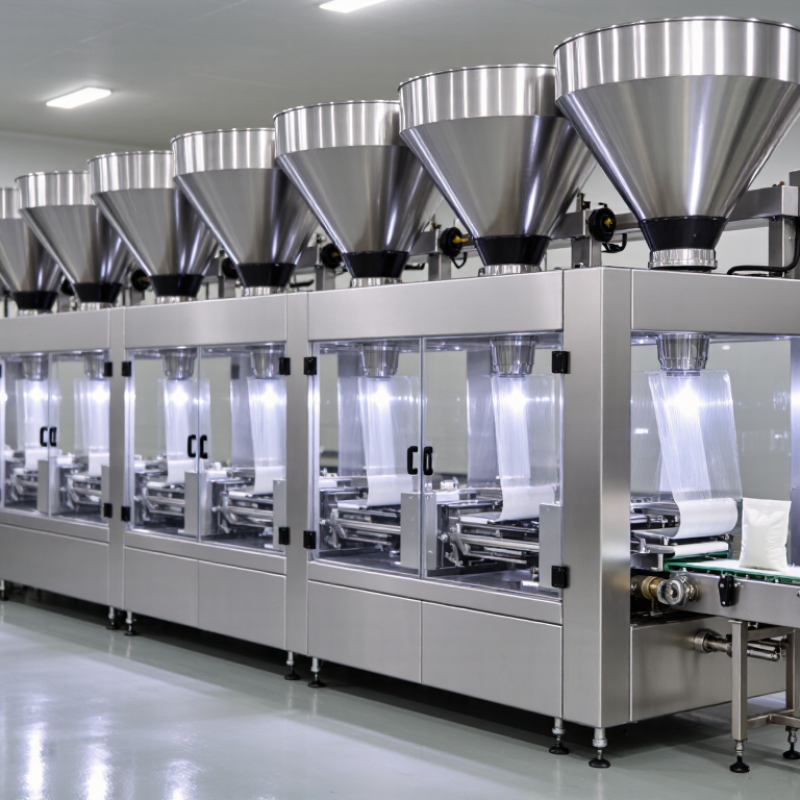
| Automation | Multi-lane forming and filling | At least 4 lanes for standard high-volume applications; 6–12 lanes may be suitable for compact sachets when product flow is stable. | More lanes can increase output without requiring a proportionally larger machine footprint, provided dosing accuracy and sealing stability are maintained. | Review the lane configuration, rated output, and actual output during a product trial using the target powder. | High |
| Automation | Servo-driven dosing and film control | Independent servo control for auger dosing, film pulling, and sealing where accurate synchronization is required. | Servo control improves repeatability, supports recipe storage, and allows faster adjustment for different fill weights and film formats. | Check the electrical drawings, motion-control list, recipe functions, and changeover demonstration. | High |
| Automation | PLC and touchscreen interface | Industrial PLC with a color touchscreen, password-protected settings, alarm history, and multilingual operating support. | A clear human-machine interface reduces operator errors and makes production data, faults, and adjustments easier to manage. | Test user permissions, alarm records, manual jogging, recipe recall, and recovery after a power interruption. | High |
| Automation | Automatic film tracking and registration | Photoelectric registration control with automatic correction for printed film and stable film tension control. | Accurate registration helps keep graphics, tear notches, and cut positions aligned across all lanes. | Run printed film at normal speed and inspect registration accuracy at startup and after roll replacement. | High |
| Automation | Production monitoring | Display of speed, total count, good packs, rejects, downtime alarms, and basic batch information. | Production visibility supports root-cause analysis, waste reduction, and more reliable capacity planning. | Confirm which values are displayed, stored, exported, or connected to the plant monitoring system. | Medium |
| Sanitation | Product-contact construction | Food-contact parts made from suitable stainless steel, commonly stainless steel grade 304; grade 316 may be selected for more corrosive environments. | Appropriate materials improve corrosion resistance, cleanability, and long-term hygiene performance. | Request material certificates or a documented material list for the hopper, auger, chute, dosing parts, and sealing-area components. | High |
| Sanitation | Open and cleanable machine design | Smooth surfaces, rounded corners, minimal horizontal ledges, accessible product-contact parts, and limited exposed threads. | Good hygienic design reduces powder accumulation and makes routine cleaning faster and more consistent. | Inspect the machine physically or through detailed photographs with guards and removable parts opened. | High |
| Sanitation | Dust containment | Enclosed powder transfer areas with provision for local dust extraction, especially for fine or airborne powders. | Dust control helps protect operators, reduce cross-contamination, limit product loss, and keep sensors and electrical areas cleaner. | Check extraction connection size, airflow requirements, sealing points, and the result of a powder-handling trial. | High |
| Sanitation | Tool-less product changeover | Dosing screws, funnels, forming parts, and contact components removable with minimal tools and clear identification. | Fast changeover reduces downtime and lowers the risk of incomplete cleaning between products. | Measure removal time and verify whether all product-contact parts can be inspected and cleaned without special equipment. | High |
| Sanitation | Cleaning procedure compatibility | Documented dry-cleaning procedure for powders, with clear restrictions on water, compressed air, and chemical exposure. | Many powders require controlled dry cleaning; unsuitable washdown practices can cause caking, corrosion, or electrical damage. | Review the sanitation manual and confirm the approved cleaning agents, cleaning frequency, and reassembly checks. | High |
| Maintenance | Auger and dosing adjustment | Quick-access auger assembly with repeatable settings for different fill weights and powder densities. | Accessible dosing components simplify calibration and reduce maintenance time when changing products. | Perform a fill-weight changeover and verify adjustment time, repeatability, and access to wear parts. | High |
| Maintenance | Preventive maintenance access | Accessible lubrication points, clearly identified wear parts, service panels, and a scheduled maintenance checklist. | Planned maintenance helps prevent unplanned stoppages and supports consistent machine performance. | Request the maintenance schedule, spare-parts list, lubrication chart, and recommended replacement intervals. | High |
| Maintenance | Diagnostic and alarm functions | Fault messages that identify the affected sensor, drive, lane, or safety circuit instead of showing only a general alarm. | Detailed diagnostics reduce troubleshooting time and help maintenance staff restore production more quickly. | Trigger common faults such as film shortage, open guard, overload, and sensor misalignment during a demonstration. | High |
| Maintenance | Spare-parts availability | Documented critical-spares list covering sensors, heaters, cutting blades, belts, seals, drive components, and electrical protection devices. | Locally available or clearly specified spare parts can reduce downtime and simplify long-term ownership. | Check part numbers, lead times, interchangeability, recommended stock levels, and service support arrangements. | Medium |
| Maintenance | Format changeover flexibility | Adjustable bag length, fill volume, sealing temperature, and cutting position with stored recipes for repeat jobs. | Flexible changeover reduces setup errors and makes the machine more suitable for multiple powder products and pack sizes. | Run at least two different pack formats and record setup time, rejected packs, and required adjustments. | High |
| Safety | Guarding and interlocked doors | Fixed guards around moving parts and interlocked access doors that stop hazardous motion when opened. | Guarding reduces access to sealing jaws, cutting devices, rotating augers, and other moving components. | Inspect each access point and test that opening a guard causes the correct controlled stop. | High |
| Safety | Emergency-stop system | Clearly visible emergency-stop devices positioned near operator and service areas, with a documented reset procedure. | Emergency stops provide rapid access to a safe shutdown in abnormal or hazardous situations. | Test every emergency-stop device and verify that restart requires deliberate reset and safe re-enable actions. | High |
| Safety | Electrical and pneumatic protection | Protected electrical enclosure, overload protection, safe isolation provisions, pressure regulation, and pneumatic dump capability where applicable. | Proper energy control helps protect personnel during operation, cleaning, adjustment, and maintenance. | Review the risk assessment, electrical schematics, isolation points, pressure settings, and lockout procedures. | High |
| Safety | Seal and cutting-area protection | Temperature monitoring, over-temperature protection, guarded sealing jaws, and controlled access to cutting mechanisms. | These features reduce burn, pinch, and cut hazards while helping maintain consistent package seals. | Check independent temperature limits, alarm behavior, guard design, and stop response during a trial run. | High |
| Safety | Risk assessment and documentation | Complete operating manual, electrical drawings, pneumatic diagrams, maintenance instructions, safety labels, and documented risk assessment. | Complete documentation supports legal compliance, operator training, troubleshooting, and safe ownership. | Review documents before purchase and confirm that manuals match the supplied machine configuration. | High |
| Performance | Filling accuracy | Validate the actual deviation against the product specification; do not rely only on a general machine rating because powder density and flowability strongly affect results. | Accurate dosing reduces giveaway, customer complaints, and out-of-specification packages. | Conduct a statistically meaningful test using the actual powder, target weight, lane count, and operating speed. | High |
| Performance | Seal integrity | Consistent hermetic or specified seal performance across all lanes at the intended film, temperature, pressure, and speed settings. | Reliable seals protect the powder from moisture, leakage, contamination, and reduced shelf life. | Perform visual inspection plus appropriate seal-strength, leak, or package-integrity testing for the product. | High |
| Performance | Realistic production capacity | Compare guaranteed output with actual good-pack output after allowing for startup, powder refill, film changes, cleaning, rejects, and minor stops. | Usable production capacity is more meaningful than the maximum no-load speed stated in a brochure. | Request a factory acceptance test using the target powder and record good packs per minute and overall downtime. | High |